
The Hidden Cost of Unrecorded Warehouse Activity
The Hidden Cost of Unrecorded Warehouse Activity
What Causes Inventory Visibility Problems in a Warehouse?
Inventory visibility problems often begin when physical warehouse events are not properly recorded. Missing trailer arrivals, unrecorded inventory moves, inaccurate yard locations, delayed receiving confirmations, and undocumented loading activities can create inventory discrepancies, shipping delays, customer service issues, and billing disputes.
Warehouse Management Systems (WMS) depend on accurate operational data. When physical warehouse activities are not captured in real time, organizations lose visibility into inventory status, trailer locations, labor requirements, shipment readiness, and customer commitments.
"Before organizations ask whether they are ready for AI, they should first ask whether they can accurately explain what happened in their operation yesterday."
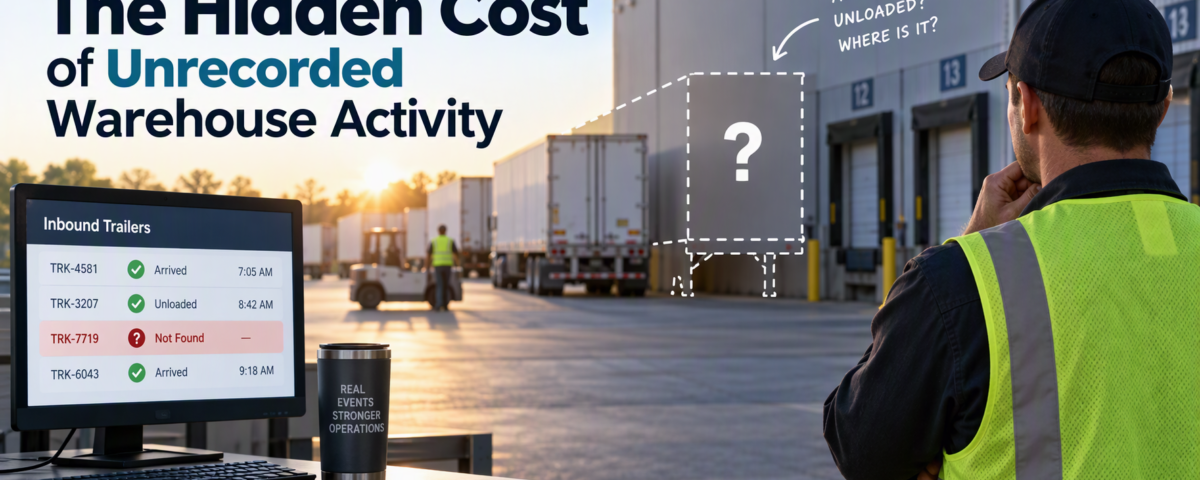
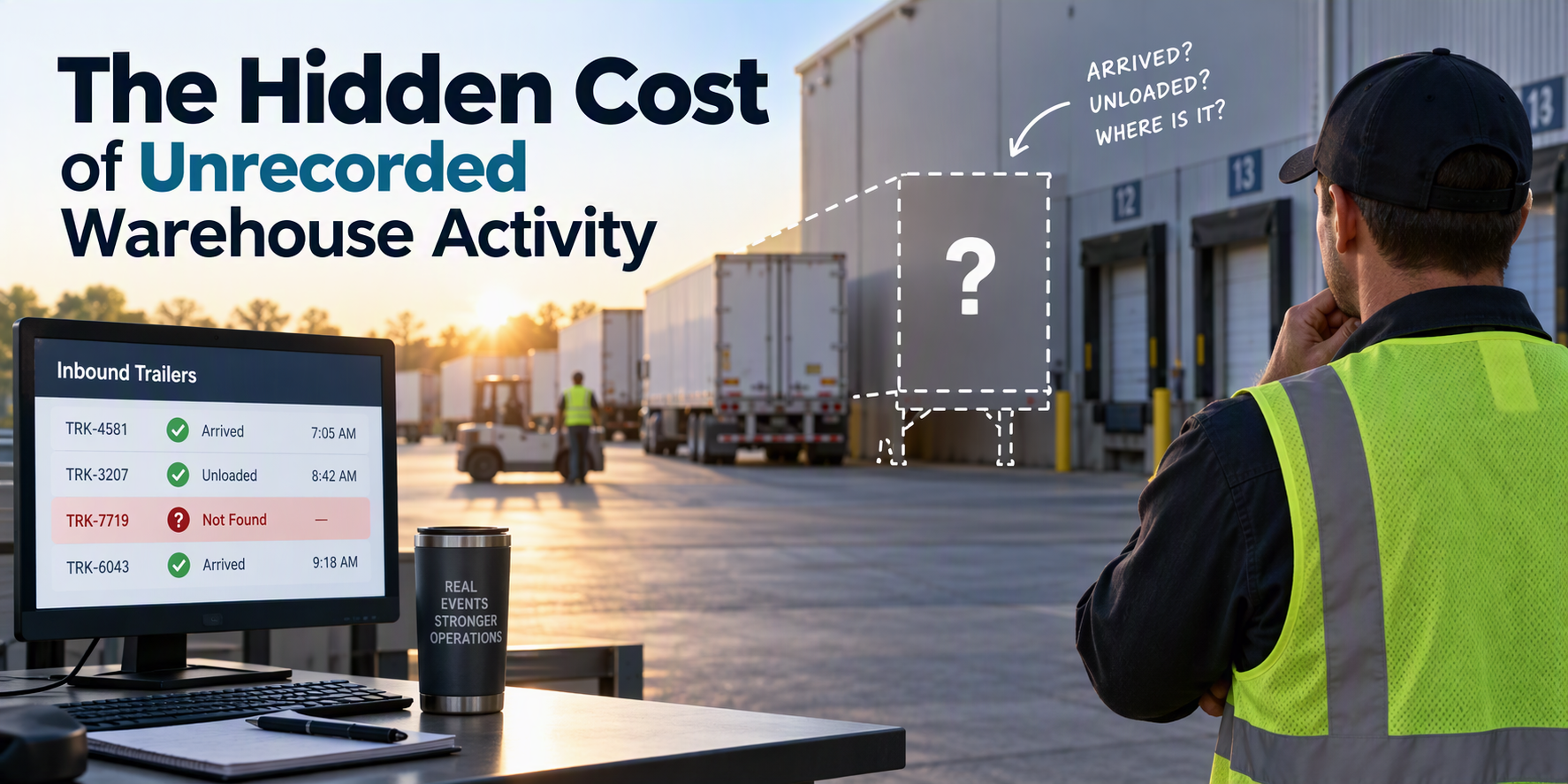
A customer wants to know why inventory promised for today is still unavailable. The warehouse management system (WMS) shows an inbound order, and the carrier says the trailer arrived yesterday. The yard team believes it is parked near receiving, but nobody can confirm whether it was unloaded. Before customer service can answer, someone has to go outside and look.
It is tempting to investigate the inventory record or request another report. A warehouse is only as effective as the operational events it can verify. Reliable warehouse event tracking helps the WMS accurately reflect activity and makes workflows more dependable. A missing arrival record can matter more than a missing software feature.
The Problem Often Starts Before the WMS
Inventory discrepancies and service failures often surface in the warehouse management system or customer service queue. That naturally directs attention to the software, even when the problem actually started hours earlier at the gate.
A trailer may arrive at 7:10 a.m. but not be entered until 9:00 a.m. The trailer may then move throughout the yard without updates to its location. By the next shift, the record no longer matches reality. Receiving labor plans become inaccurate, dock schedules are disrupted, and inventory availability becomes questionable.
Warehouse visibility cannot stop at the warehouse walls. Inbound and outbound operations depend on trailer tracking, yard management, dock activity, and real-time operational awareness. These physical conditions directly affect warehouse execution and customer service performance.
One Missed Record Can Become Several Problems
Arrival, receipt, and inventory availability are different states of warehouse activity. Each event requires separate confirmation. When any step is assumed instead of verified, inventory accuracy becomes vulnerable.
Imagine a pallet being moved to an overflow area without recording the move. The inventory still exists physically, but the next shift cannot find it. Supervisors dispatch employees to search for inventory, fulfillment operations slow down, and customers experience shipping delays despite products appearing to be available.
The financial implications are equally significant. Without reliable arrival and departure records, organizations may struggle to validate detention charges, waiting time, and value-added services. Repeated billing disputes weaken customer trust and increase administrative costs.
Likewise, a scheduled pickup does not necessarily prove departure. Reporting a shipment as collected when it remains in the yard creates visibility issues, missed service commitments, and customer dissatisfaction.
Start Where the Record Stops
Organizations seeking better warehouse operational intelligence should begin with a recent discrepancy or disputed invoice and trace the process backward. Identify where system-recorded events give way to handwritten notes, phone calls, emails, radio discussions, or individual memory.
For each operational event, organizations should capture:
- The asset, trailer, pallet, or shipment involved
- What activity occurred
- Where it happened
- When it occurred
- Who verified the event
Warehouse data quality improves when event times are clearly separated from entry times, ownership of records is defined, and exceptions remain unresolved until verification occurs.
Effective warehouse data capture processes fit naturally into operational workflows rather than relying on duplicate entry or reconstruction after the work has already been completed.
Physical AI Starts with Physical Data
Analytics platforms, dashboards, and artificial intelligence systems can only evaluate the information they receive. They cannot validate an unload that was never confirmed or explain delays caused by an unrecorded yard movement.
This is why physical AI starts with physical data. AI applications that support warehouse operations require dependable information about actual conditions, inventory location, shipment status, completed tasks, and operational events.
Poor warehouse data quality produces poor analytical outcomes. AI systems trained on inaccurate operational records may repeatedly recommend incorrect staffing, scheduling, and workflow decisions.
The benefits of accurate event capture reach far beyond AI initiatives. Reliable operational records improve inventory accuracy, customer service, warehouse productivity, billing accuracy, labor planning, and supply chain visibility.
Organizations do not need to document everything before improving anything. They simply need to close the operational gaps that repeatedly create delays, confusion, extra labor, and unnecessary work. Once trusted operational data becomes available, both people and software systems can make better decisions.
Frequently Asked Questions
What is unrecorded warehouse activity?
Unrecorded warehouse activity refers to any physical movement, inventory transfer, trailer arrival, shipment departure, or operational event that occurs without being documented in warehouse systems.
Why is warehouse event tracking important?
Warehouse event tracking supports inventory accuracy, labor planning, shipment visibility, customer service, billing validation, and operational accountability.
How do missing warehouse records affect inventory accuracy?
Missing records can cause inventory to appear unavailable, become difficult to locate, incorrectly show as received, or delay fulfillment operations.
What causes warehouse visibility issues?
Common causes include manual processes, delayed data entry, poor yard management, disconnected systems, paper-based workflows, and unrecorded operational activities.
How does warehouse data quality affect AI initiatives?
Artificial intelligence depends on accurate operational data. Missing or inaccurate event records reduce the reliability of AI-generated recommendations and analytics.
What is the relationship between yard management and warehouse performance?
Yard management directly affects receiving, shipping, labor planning, dock scheduling, inventory availability, and customer service performance.