
How 3PL Warehouses Can Compete with Amazon Supply Chain Services
Amazon has officially entered the broader third-party logistics arena with the launch of Amazon Supply Chain Services (ASCS), opening its freight, distribution, fulfillment, and parcel shipping network to businesses of all sizes. According to Amazon, companies can now leverage the same infrastructure that powers Amazon’s retail operations and marketplace ecosystem, including transportation, warehousing, fulfillment, and multi-channel distribution capabilities.
At first glance, this announcement may sound intimidating to independent 3PL warehouses. After all, Amazon has spent decades building one of the world’s most sophisticated logistics networks. But if history has taught us anything, it’s that large-scale logistics solutions don’t eliminate the need for specialized service providers. In many cases, they create new opportunities.
The reality is that 3PLs possess several competitive advantages that Amazon can’t easily replicate. The key is understanding where to focus.
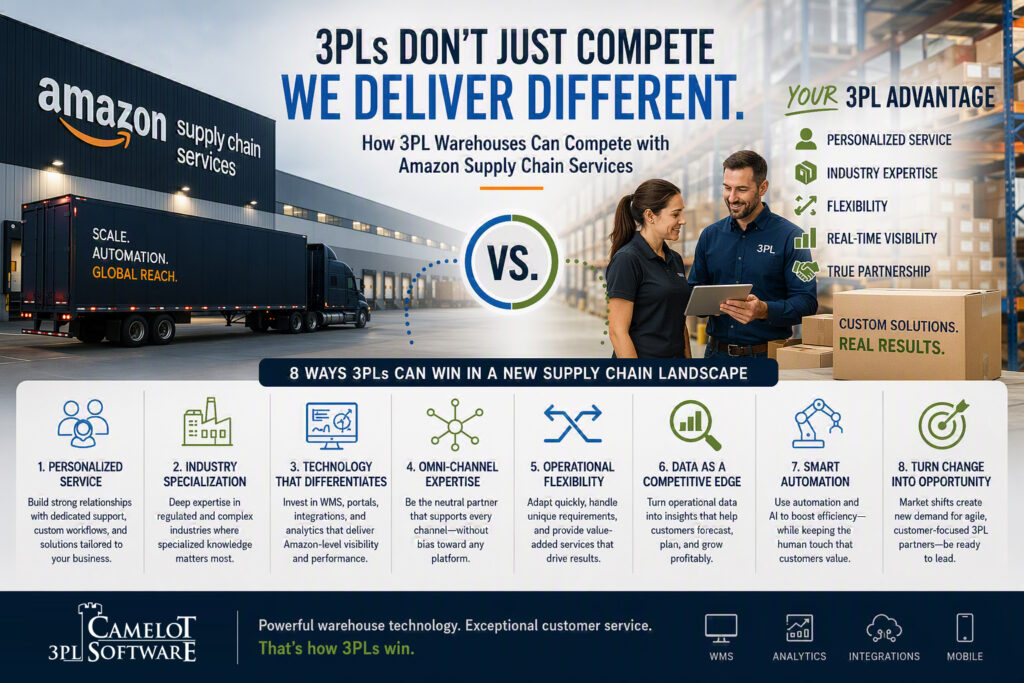
1. Double Down on Personalized Service
One of the biggest differences between Amazon and a traditional 3PL is the customer relationship.
Amazon excels at scale. Most 3PLs excel at partnership.
Many shippers, especially growing brands, manufacturers, distributors, and niche retailers, don’t want to become just another account in a giant network. They want direct access to decision-makers, fast responses to unique requests, and logistics partners who understand their business.
Independent 3PLs can win by offering:
- Dedicated account management
- Customized workflows
- Flexible billing structures
- Specialized reporting
- Strategic consulting and operational guidance
When a customer calls your operation, they should reach someone who knows their business..
2. Focus on Industry Specialization
Amazon’s model is designed for broad applicability. Most 3PLs have the opportunity to become experts in specific verticals.
Whether it’s:
- Healthcare
- Industrial manufacturing
- Food and beverage
- Cold storage
- Automotive parts
- B2B distribution
- Hazardous materials
- Retail replenishment
Specialized expertise often outweighs scale.
Customers operating in regulated or highly complex industries frequently need unique inventory controls, compliance reporting, lot traceability, serial number management, customer-specific labeling, and specialized handling procedures.
These are areas where focused 3PL operators can maintain a significant competitive advantage.
3. Invest in Technology That Creates Differentiation
Competing with Amazon doesn’t mean building an Amazon-sized network. It means delivering an Amazon-level customer experience.
Modern shippers expect:
- Real-time inventory visibility
- Web-based customer portals
- Mobile access
- Automated notifications
- EDI integration
- Marketplace connectivity
- Data analytics
- KPI dashboards
This is where technology becomes a force multiplier.
At Camelot, we consistently see successful 3PLs leverage advanced warehouse management systems to create operational efficiencies and customer experiences that rival much larger organizations. Features like customized workflows, customer-specific billing, real-time inventory visibility, and integrated analytics help smaller operators compete on value rather than size. Similar capabilities are highlighted throughout Camelot’s own WMS platform and analytics offerings.
4. Become the Omni-Channel Expert
Ironically, Amazon’s strength can also be a limitation.
Many brands today sell through multiple channels:
- Direct-to-consumer websites
- Amazon Marketplace
- Walmart Marketplace
- Shopify stores
- Retail distributors
- Brick-and-mortar locations
- B2B customers
While Amazon promotes a unified inventory pool and multi-channel fulfillment capabilities, many companies prefer a logistics provider that operates independently of any single sales platform.
3PLs can position themselves as neutral supply chain partners that support every channel equally, helping customers avoid excessive reliance on a single ecosystem.
5. Offer Operational Flexibility Amazon Can’t Match
The larger an organization becomes, the harder it is to accommodate exceptions.
Successful 3PLs often thrive because they can:
- Handle unique packaging requirements
- Support custom kitting operations
- Adapt workflows quickly
- Support customer-specific compliance standards
- Create value-added services
Many customers are willing to pay more for flexibility when that flexibility directly impacts their service levels or customer experience.
Agility remains one of the most powerful weapons available to independent warehouse operators.
6. Use Data as a Competitive Advantage
Historically, warehousing providers were judged by storage capacity and throughput.
Today’s leading 3PLs are becoming information providers.
Customers increasingly expect:
- Order trends
- Inventory forecasting
- Space utilization metrics
- Labor productivity reporting
- Customer profitability analysis
- Demand insights
The most successful 3PLs are helping customers make better business decisions… not just ship products.
Technology-enabled visibility can transform a warehouse from a cost center into a strategic partner.
7. Embrace Automation Without Losing the Human Element
Amazon is synonymous with robotics, automation, and AI-driven logistics.
Independent 3PLs should absolutely continue investing in automation where it drives measurable value:
- Directed picking
- Mobile warehouse execution
- AI-assisted reporting
- Labor optimization
- Automated replenishment
- Cycle count management
However, automation should enhance customer service… not replace it.
The winning formula isn’t “be more like Amazon.”
It’s “combine modern technology with exceptional service.”
That’s a combination Amazon’s scale makes difficult to replicate.
8. Turn Amazon’s Expansion Into an Opportunity
Industry shifts often create new market opportunities.
Recent logistics trends suggest that as large players continue to internalize portions of their supply chains, many mid-sized retailers, manufacturers, and specialty brands are seeking alternative logistics partners that offer flexibility, lower risk, and greater personalization. Internal industry research also points to growing demand for outsourcing and specialized 3PL relationships as companies seek agility and avoid large fixed infrastructure investments.
Rather than viewing Amazon solely as a threat, forward-thinking 3PLs should view the launch of Amazon Supply Chain Services as further validation of the value that outsourced logistics provides.
The market is growing. Customer expectations are evolving. And there is plenty of room for providers that deliver something different.
Final Thoughts
Amazon Supply Chain Services will undoubtedly attract attention. Its combination of freight, warehousing, fulfillment, and transportation services represents a formidable offering for businesses seeking scale and simplicity.
But 3PL success has never been about having the biggest network.
It’s about delivering the right combination of service, flexibility, expertise, and technology.
The warehouses that thrive over the next decade won’t be the ones trying to out-Amazon Amazon. They’ll be the ones that leverage technology, deepen customer relationships, specialize in industries they know best, and become indispensable supply chain partners.
At Camelot 3PL Software, we believe the future belongs to agile 3PLs that combine powerful warehouse technology with exceptional customer service. In a world increasingly driven by automation and scale, personalization may become the ultimate competitive advantage.